SIM Card Types in Pakistan: Physical SIM, eSIM, Prepaid, Postpaid and Data SIMs
Compare SIM card types in Pakistan — physical SIM, eSIM, prepaid, postpaid, data SIMs, sizes, IoT options, and how to choose the right one for your phone.
Quick answer
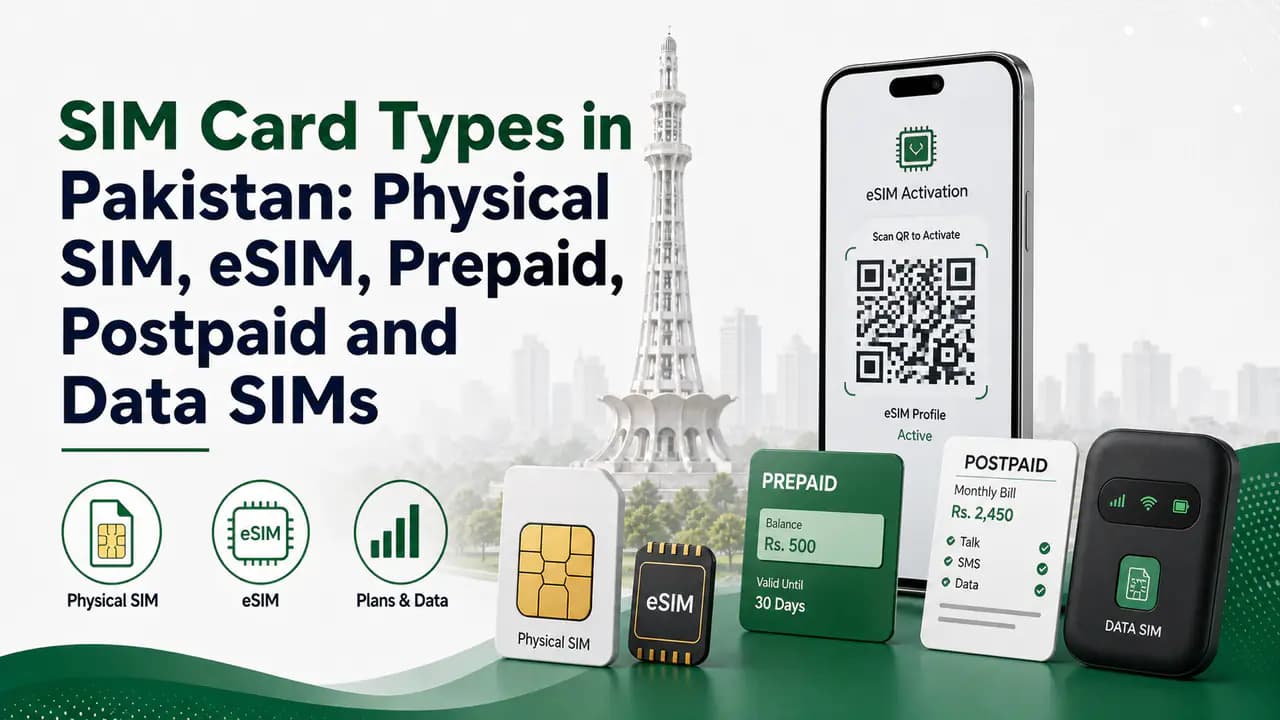
A SIM card is what connects your mobile phone or another compatible device to a cellular network. In Pakistan, SIMs are available in several forms and service categories. The most familiar option is the small physical SIM that you insert into your phone, but eSIM technology is also available from major operators.
There are also different service types, including prepaid, postpaid and data-focused SIMs. Choosing the right one depends on your phone, how you use mobile data, whether you need regular calls, and the network coverage available in your area.
This guide explains the main types of SIM cards in Pakistan, how they differ, and which type may be suitable for different users.
What Is a SIM Card?
SIM stands for Subscriber Identity Module. A SIM allows a compatible device to identify and authenticate itself with a mobile network. It is associated with a mobile subscription and can be used for services such as:
- Voice calls
- SMS
- Mobile internet
- Network authentication
- Mobile-number-based services
- Roaming
A SIM does not necessarily have to be a removable plastic card. Modern phones can also use an eSIM, which stores the SIM profile electronically inside the device.
Main Types of SIM Cards in Pakistan
The easiest way to understand SIM types is to divide them into two groups.
Based on Physical Form
- Physical SIM
- eSIM
Based on Service Type
- Prepaid SIM
- Postpaid SIM
- Data or internet SIM
- Specialized business and IoT/M2M SIMs
These categories can overlap. For example, you can have a prepaid physical SIM, a postpaid physical SIM, or an eSIM attached to a particular type of mobile subscription.
1. Physical SIM
The traditional physical SIM is the removable SIM card most people are familiar with. It is inserted into a SIM slot on a compatible phone, tablet, router, mobile broadband device or another cellular device. The physical SIM contains the information required for the device to authenticate with the mobile network.
Advantages of a Physical SIM
Physical SIMs remain popular because they are simple and widely supported. You can:
- Remove the SIM from one phone
- Insert it into another compatible phone
- Replace a damaged SIM
- Keep the same number when changing compatible devices
- Use it in many devices that do not support eSIM
For people who regularly change phones, a physical SIM can be convenient because moving the subscription usually only requires moving the card.
Disadvantages
The main disadvantage is that you physically have to handle the card. It can be lost, damaged, bent, misplaced, or accidentally removed. You also need a compatible physical SIM slot.
2. SIM Sizes: Mini, Micro and Nano SIM
Physical SIM cards have existed in several sizes. The commonly known formats include:
- Mini SIM
- Micro SIM
- Nano SIM
Older phones often used larger SIM formats, while modern smartphones generally use the much smaller nano-SIM. The important point is that these are mainly different physical sizes, not completely different mobile network services. A nano-SIM and a micro-SIM can both provide the same basic type of mobile connection when used with compatible equipment and subscription services.
What Is a Nano-SIM?
Nano-SIM is the small physical SIM format commonly found in modern smartphones. Many current phones use a nano-SIM slot. Before purchasing a physical SIM, check which SIM size your phone accepts. Some operators may provide a multi-size SIM that can be separated into the required size, but this depends on the operator and SIM product.
3. eSIM
An eSIM, or embedded SIM, is a digital SIM profile stored in compatible hardware rather than on a removable plastic SIM card. Instead of inserting a card into the phone, the operator provides an eSIM profile that can be installed on the compatible device.
Major Pakistani operators offer eSIM services.
Jazz currently provides eSIM activation through its Experience Centers, franchises and eligible retailers. Its official information says customers receive a QR code after registration and can add the cellular plan through their phone settings. See Jazz SIM information for operator-specific details.
Zong also offers eSIM and explains that customers can obtain it through its Customer Service Centres or franchises after the required verification process. See Zong SIM information for more.
Ufone likewise offers eSIM and requires biometric verification before activation. See Ufone SIM information for current eSIM guidance.
How Does an eSIM Work?
Instead of inserting a plastic card, the operator provides an eSIM profile. Depending on the operator and device, activation generally involves:
Typical eSIM activation steps
Get the eSIM through the operator's authorized channel
Visit an official franchise, service centre, or eligible retailer for the operator you choose.Complete the required biometric verification
Operators require identity verification according to applicable telecom rules before activating a new connection.Receive the eSIM QR code or activation information
The operator provides the profile details needed to install the eSIM on your device.Connect the phone to the internet
An active internet connection is usually required to download the eSIM profile.Open the SIM or cellular settings
On a compatible phone, navigate to the mobile or cellular settings menu.Select the option to add a mobile/cellular plan
The exact menu wording varies by phone manufacturer and operating system.Scan the QR code
Use your phone's camera or the built-in eSIM setup tool to scan the code provided by the operator.Download and activate the eSIM profile
Follow the on-screen prompts to complete installation. The exact process can vary between operators and devices.
Advantages of eSIM
eSIM has several advantages.
No Physical SIM Card
There is no plastic card to insert or remove.
Useful for Dual-SIM Phones
Some compatible phones can operate a physical SIM and an eSIM at the same time. This can be useful if you want one number for personal use and another for work, one local number and another for travel, or similar dual-line setups. The exact number of active lines depends on the device.
Convenient When Changing Plans
Compatible devices can store multiple cellular profiles, although the number that can be active simultaneously depends on the phone.
Harder to Physically Remove
Because there is no removable SIM card, someone cannot simply take the SIM out of the phone. However, this does not mean eSIM is automatically protected against SIM-swap fraud or account takeover. PTA has published security guidance about SIM swapping, where an attacker attempts to persuade a carrier to move a victim's number to another SIM.
Disadvantages of eSIM
eSIM is not perfect for everyone. You need:
- An eSIM-compatible phone
- An operator that supports eSIM
- Proper eSIM activation
- Access to the activation information
If you change phones, the process for transferring or reactivating an eSIM can be different from simply removing a physical SIM and inserting it into another phone.
Do not share your eSIM QR code
For a deeper comparison, see eSIM vs physical SIM.
4. Prepaid SIM
A prepaid SIM is a mobile subscription where you generally pay before using services. You add balance or subscribe to a package and then use the available services. Prepaid is one of the most common choices for everyday mobile users in Pakistan.
How Prepaid Works
For example, you might:
Typical prepaid usage flow
Buy a prepaid SIM
Purchase through an official operator franchise or authorized channel with required verification.Add balance
Top up through the operator's recharge channels or retail outlets.Subscribe to an internet, call or SMS package
Choose a package that matches your usage. Options vary between operators.Use the allocated resources
Make calls, send messages, and use mobile data according to your active package or balance.Recharge when the balance or package expires
The exact packages, validity periods and prices vary between operators.
Advantages of Prepaid SIM
Prepaid is useful if you want control over your spending. Benefits include:
- No regular monthly bill in the traditional postpaid sense
- Easy balance management
- Large variety of short-term packages
- Useful for occasional users
- Easy to change packages according to your needs
Prepaid can be particularly useful for students and people who do not want a fixed monthly commitment.
Disadvantages
You need to maintain sufficient balance or an active package. If you forget to recharge, services may become limited according to the operator's rules and the status of the account.
5. Postpaid SIM
A postpaid SIM works differently. Instead of paying before using the service, you generally use services during a billing period and then receive a bill. Postpaid plans are often aimed at users who need regular monthly service.
Advantages of Postpaid
A postpaid connection can be useful if:
- You make many calls
- You use large amounts of mobile data
- You need a predictable monthly plan
- You use the number for business
- You want additional account or billing options
Some postpaid plans also provide features designed for business or higher-usage customers.
Disadvantages
The biggest difference is the billing system. You need to monitor your usage and pay the bill according to the operator's terms. A postpaid connection may also require a security deposit depending on the package and operator. For example, Ufone currently lists security deposits as applicable to certain postpaid subscriptions.
For a side-by-side comparison of billing models, see prepaid vs postpaid SIM.
6. Data or Internet SIM
A data SIM is primarily intended for mobile internet rather than ordinary phone use. It can be useful in:
- 4G/5G routers
- Mobile Wi-Fi devices
- Tablets
- Internet dongles
- Portable hotspots
- Other compatible data devices
Operators offer dedicated internet SIM products and data packages. For example, Zong currently offers Internet SIM packages with different data allowances and validity periods.
Who Should Use a Data SIM?
A data SIM may be useful if you need mobile internet for:
- A portable router
- A secondary internet connection
- A tablet
- A laptop through a compatible modem
- A home or office backup connection
If your primary requirement is internet rather than traditional voice calls, a data-focused package may make more sense than choosing a normal voice package.
7. Voice SIM
A voice SIM is a normal mobile subscription intended for everyday communication. Depending on the package, it can support calls, SMS, and mobile data. The distinction between a voice SIM and a data SIM can depend on the operator's particular product.
For an ordinary smartphone user who needs calls, SMS and internet, a standard mobile SIM is generally the simplest option.
8. Business and Corporate SIMs
Businesses may have different requirements from individual customers. A company may need multiple numbers for:
- Employees
- Sales teams
- Customer support
- Field workers
- Managers
- Business communication
Operators offer business and corporate telecom solutions that can include mobile connections and other communication services. The exact features depend on the operator and business plan. If you are managing many company numbers, it is better to look at the operator's business offerings rather than treating every connection like an ordinary individual prepaid SIM.
9. IoT and M2M SIMs
Some SIMs are designed for machines rather than people. These are commonly associated with IoT (Internet of Things) and M2M (Machine-to-Machine) communication. Examples include:
- Vehicle trackers
- Security systems
- Smart meters
- Industrial equipment
- GPS devices
- Monitoring equipment
- Connected machines
These devices may need a cellular connection but do not need a person to make normal phone calls. The requirements and commercial arrangements for these connections can be very different from ordinary consumer SIMs.
Physical SIM vs eSIM
The choice between physical SIM and eSIM mostly depends on your phone and how you use it.
Neither option is automatically better for everyone.
Prepaid vs Postpaid SIM
Another important decision is whether you need prepaid or postpaid.
If you use your phone casually, prepaid may be easier. If you use a large amount of data or make frequent calls every month, postpaid may be worth considering.
How to Choose the Right SIM in Pakistan
Choosing a SIM should not be based only on the advertised package price. Consider these factors.
1. Check Network Coverage in Your Area
The cheapest package is not useful if the network performs poorly where you live or work. Check coverage in the places where you spend most of your time:
- Home
- Office
- University
- Village
- Market
- Roads you regularly travel
Network performance can vary considerably from one location to another.
2. Check Which Network Works Best Near You
If possible, ask people who actually use different networks in your area. A network that works very well in one city or neighborhood may not perform the same way somewhere else. For mobile internet, pay attention to:
- Download speed
- Upload speed
- Ping/latency
- Indoor signal
- Call quality
- Performance during busy hours
3. Check the Nearest Tower
Tower location can help you understand why a network performs differently in different areas. However, the nearest tower is not automatically the best tower. Performance also depends on:
- Frequency bands
- Tower capacity
- Network technology
- Building obstruction
- Terrain
- Number of connected users
- Signal strength
- Sector orientation
Therefore, use tower information as one clue rather than the only factor.
4. Test the Network Before Switching Permanently
If you are unsure which operator is best, ask friends or family members in your area about their experience. You can also use a temporary connection where appropriate and test:
- Calls
- 4G/5G data
- Indoor coverage
- Outdoor coverage
- Speed
- Reliability
Real-world testing is often more useful than choosing based only on advertisements.
5. Check Whether Your Phone Supports the SIM Type
Before buying an eSIM, make sure your phone actually supports eSIM. If you want a physical SIM, check the correct SIM format. Also check whether your phone supports the network technologies and frequency bands used by the operator.
SIM Registration in Pakistan
SIM registration is not simply a matter of inserting a card into a phone. Operators require customer verification according to applicable telecom rules.
Use official operator channels only
For a new SIM, use the operator's official franchise, service centre or authorized channel and complete the required biometric verification. Do not allow an unknown person to perform unnecessary biometric attempts or register additional SIMs in your name. See SIM registration for broader registration context.
Check Your SIM Registrations After Getting a New SIM
This is an important security habit. After purchasing or replacing a SIM, you can check the SIMs associated with your CNIC using the official PTA SIM Information System. The system provides the number of SIMs registered against the identity and separates the count by operator.
This is useful because you want your telecom records to match the SIMs you actually requested. If you notice an unexpected registration, contact the relevant operator and ask them to investigate.
Use the CNIC SIM check page or the guide on how to check SIMs registered on a CNIC for the official procedure.
Can One Phone Use Both a Physical SIM and eSIM?
Yes, many modern phones support combinations of physical SIM and eSIM. For example, a compatible phone may allow a physical SIM for your personal number and an eSIM for your work number.
However, the exact configuration depends on the phone model. Some phones can keep multiple eSIM profiles stored while allowing only a certain number of lines to be active at the same time. Always check your specific phone's specifications.
Can You Convert a Physical SIM to eSIM?
Yes, where the operator supports it. Jazz, Zong and Ufone currently provide eSIM services and offer processes for existing customers to move from a physical SIM to an eSIM, subject to their requirements.
For example, Jazz states that an existing physical SIM can be replaced with an eSIM, after which the physical SIM for that number is deactivated. The exact charges and procedure can change, so check the operator's current official information before visiting a franchise.
Is eSIM Safer Than a Physical SIM?
Not necessarily. eSIM removes the physical card, which means someone cannot simply remove the card from your phone. But eSIM does not eliminate risks such as:
- SIM swapping
- Phishing
- Account takeover
- Stolen credentials
- Social engineering
PTA has specifically warned about SIM-swap fraud, where criminals attempt to convince a mobile carrier to transfer a victim's number to another SIM. So regardless of whether you use physical SIM or eSIM, protect your personal information and verification codes.
Which SIM Type Is Best for You?
There is no single best SIM for everyone.
For a Normal Smartphone User
A standard prepaid physical SIM is usually the simplest option.
For Someone Who Wants Two Numbers
An eSIM plus physical SIM can be convenient if your phone supports the combination.
For Heavy Monthly Users
A postpaid plan may be worth considering.
For People Who Want Strict Spending Control
Prepaid is generally easier to manage.
For Tablets and Routers
A data-focused SIM may be more appropriate.
For Connected Machines
An IoT/M2M solution may be more suitable than an ordinary consumer SIM.
For Frequent Phone Upgrades
A physical SIM can be convenient because it can generally be moved between compatible devices without downloading a new profile.
Frequently Asked Questions
SIM card types in Pakistan FAQ
Related articles
Prepaid vs Postpaid SIM in Pakistan: Which One Should You Choose?
Compare prepaid vs postpaid SIMs in Pakistan, including costs, billing, packages, advantages, disadvantages and which SIM type is best for you.
What Is an eSIM? Complete Guide to eSIM Technology in Pakistan
What an eSIM is, how it works in Pakistan, Jazz/Zong/Ufone activation steps, advantages and disadvantages, safety tips, PTA/DIRBS notes, and FAQs.
eSIM vs Physical SIM: Which One Is Better?
Compare eSIM and physical SIM in Pakistan: activation, security, travel, device compatibility, dual-SIM use, conversion, and which option suits your needs.
Jazz SIM Information in Pakistan
Find Jazz SIM information in Pakistan, including number check, SIM ownership, verification, replacement, Jazz codes, SIMOSA and official support.
Zong SIM Information in Pakistan
Find Zong SIM information in Pakistan, including *8# number check, SIM registration, biometric verification, replacement, eSIM and official support.
Ufone SIM Information in Pakistan: Number, Ownership, Verification and Registration Guide
Find Ufone SIM information in Pakistan, including number and ownership checks, SIM verification, registration, replacement and official support.
Telenor SIM Information in Pakistan
Find Telenor SIM information in Pakistan, including number and ownership checks, SIM verification, replacement, USSD codes and official support.
About the author
Bottom Line
The term "SIM card" covers more than one type of product. You can choose between a traditional physical SIM and an eSIM, while your actual mobile service can be prepaid, postpaid, data-focused or designed for specialized applications.
For most people, the decision is simple: first check your phone, then check the network coverage in your area, and finally choose the service type that matches your usage.
Do not choose a SIM simply because a package looks cheap. A reliable connection where you actually live, work and travel is usually more valuable than a few extra gigabytes or a slightly cheaper package.
And whatever type of SIM you choose, register it through an official channel and keep your SIM registration information under control.