eSIM vs Physical SIM: Which One Is Better?
Compare eSIM and physical SIM in Pakistan: activation, security, travel, device compatibility, dual-SIM use, conversion, and which option suits your needs.
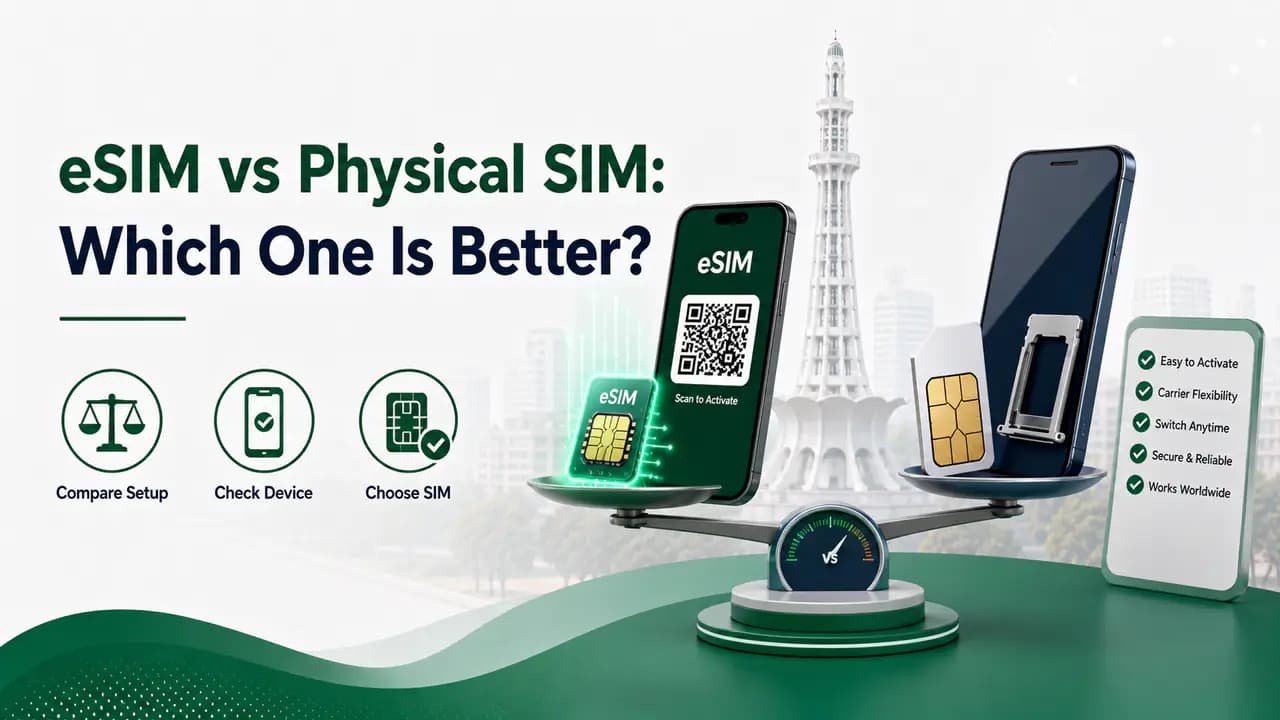
Choosing a SIM card used to be very simple. You bought a small plastic SIM, inserted it into your phone, and started using your mobile number. Today, there is another option: the eSIM.
An eSIM does not require a physical card. Instead, the SIM functionality is built into the phone, and the mobile operator provides a digital SIM profile that can be installed on the device.
Both options can provide the same basic mobile services, including calls, SMS and mobile internet. The main difference is how the mobile subscription is stored and activated.
So, which is better: eSIM or physical SIM?
The answer depends on your phone, how often you change devices, whether you travel, and how much convenience you want.
This guide explains the differences between eSIM and physical SIM, their advantages and disadvantages, security considerations, activation process, and which option may be more suitable for users in Pakistan.
30 sec readQuick answer
What Is a Physical SIM?
A physical SIM is the traditional SIM card that you insert into a compatible slot in your mobile phone.
The small card contains information that allows your mobile network to identify and authenticate your subscription.
Physical SIM cards have been used for many years and remain extremely common in Pakistan.
When you purchase a new SIM from a mobile operator, you normally receive a physical SIM after completing the required registration and biometric verification.
Depending on the operator and phone, the SIM may be used for:
- Voice calls
- SMS
- Mobile data
- Mobile network authentication
- Number-based services
Physical SIMs are also convenient when moving your number from one compatible phone to another. In many cases, you simply remove the card from the old phone and insert it into the new one.
What Is an eSIM?
An eSIM, short for embedded SIM, is a SIM that is built into the device. For a broader introduction to the technology, see what is an eSIM.
There is no removable plastic SIM card. Instead, the operator provides an eSIM profile that is downloaded to the phone, commonly using a QR code.
For example, current eSIM information published by Jazz, Zong and Ufone describes a process involving registration/biometric verification followed by downloading the eSIM profile using a QR code.
Once the profile has been installed, the phone connects to the operator in much the same way as it would with a traditional SIM.
The important thing to understand is that eSIM does not mean a different type of mobile network.
Your operator still provides the network service. The main difference is that the SIM profile is stored digitally inside the phone rather than on a removable card.
eSIM vs Physical SIM at a Glance
The exact features depend on the phone and mobile operator.
How Does an eSIM Work?
The process can sound complicated, but for the user it is relatively straightforward.
First, you obtain an eSIM from your mobile operator.
After completing the required registration and biometric verification, the operator provides an eSIM activation method, commonly a QR code.
You connect your phone to the internet and open the mobile or cellular settings.
You then select the option to add a cellular/mobile plan and scan the QR code.
The phone downloads the eSIM profile and activates the mobile subscription.
For example, Zong's current instructions describe obtaining the eSIM through a customer service centre or franchise, completing biometric verification, receiving an eSIM QR-code voucher, and downloading the profile through the phone's cellular settings.
Ufone similarly describes a process involving BVS registration, an eSIM QR code and scanning that code on the compatible phone.
Jazz also provides eSIM activation through its Experience Centers, franchises and eligible retailers.
How Does a Physical SIM Work?
A physical SIM is simpler from a hardware perspective.
You receive the SIM card from your operator after completing the required registration process.
The card is inserted into the phone's SIM tray.
The phone detects the SIM and connects to the operator's network.
If you change phones, you can normally remove the SIM from the old phone and put it into the new compatible phone.
This is one of the biggest reasons physical SIMs remain popular.
There is no need to download a profile or deal with QR codes.
Advantages of eSIM
1. No Physical SIM Card
The biggest difference is obvious: there is no plastic card to carry.
You do not have to worry about the SIM becoming damaged, bent or lost.
The SIM functionality is already built into the phone.
2. Useful for Dual-SIM Phones
Many modern smartphones can combine a physical SIM with an eSIM.
This can allow you to use two mobile subscriptions on one phone.
For example, someone might use:
- One number for personal calls
- Another number for business
- One local number and one travel number
- One voice number and another data connection
The exact configuration depends on the phone.
Some phones can store multiple eSIM profiles, although the number that can be active simultaneously depends on the device.
Jazz and Ufone both state that compatible iPhones can store multiple eSIM accounts, while only supported configurations can be active at the same time.
3. Convenient for International Travel
eSIM can be particularly useful when travelling.
Instead of physically removing your normal SIM, you may be able to add a travel eSIM while keeping your existing SIM profile available.
This can make it easier to maintain your usual number while using another mobile plan for data.
However, you should always check whether your phone is unlocked and whether the destination operator or travel provider supports eSIM.
4. Harder to Physically Remove
A physical SIM can be removed from a phone.
An eSIM cannot simply be pulled out.
This can be an advantage if the phone is lost or stolen because there is no physical SIM card for someone to remove.
However, this does not mean an eSIM makes a stolen phone completely secure. Your phone's screen lock, account security and operator controls are still important.
5. Saves Physical Space
Because the phone does not need a removable SIM card for the eSIM connection, manufacturers have more flexibility in how internal components are designed.
This is one reason eSIM technology is becoming increasingly common in newer smartphones.
Disadvantages of eSIM
eSIM has several advantages, but it is not automatically better for everyone.
1. Your Phone Must Support eSIM
This is probably the biggest limitation.
An eSIM cannot be used on a phone that does not have eSIM hardware support.
Having a modern phone does not automatically mean it supports eSIM.
You should check the exact model and regional variant of your phone before purchasing or converting to eSIM.
Some phones have different SIM capabilities depending on the country or model.
2. Moving Your Number to Another Phone Can Be Less Convenient
With a physical SIM, moving your number can be as simple as removing the card and inserting it into another phone.
With an eSIM, moving to another phone may require the operator's eSIM transfer or replacement procedure.
For example, Jazz states that after certain situations such as a factory reset, the eSIM activation can be lost and the customer may need to visit an outlet again for reactivation and a new QR code.
Zong also provides specific instructions for eSIM profile handling when changing handsets.
This makes physical SIMs more convenient for people who frequently change phones.
3. Losing the Activation QR Code Can Be a Problem
The QR code used for eSIM activation should be treated as sensitive information.
Do not send a photograph of your eSIM QR code to strangers or post it online.
Operators themselves warn customers not to share eSIM QR codes for security reasons.
4. Factory Reset Can Affect the eSIM
Depending on the device and operator, deleting the eSIM profile or performing certain reset procedures can remove the installed profile.
You should therefore understand how your operator handles eSIM reactivation before relying on it as your only connection.
Advantages of Physical SIM
1. Easy to Move Between Phones
This is the biggest advantage of a physical SIM.
Suppose your phone stops working.
You can remove the SIM, put it into another compatible phone, and continue using your number.
This is particularly useful when travelling or when you regularly switch between devices.
2. Works With a Huge Range of Phones
Physical SIM technology is supported by a very large number of phones.
Even many older smartphones can use a physical SIM.
This makes it a practical choice if you do not want to worry about eSIM compatibility.
3. Simple to Understand
For many users, the physical SIM is simply easier.
Insert the card, restart or wait for the network, and use the phone.
There are no QR codes or digital profiles to manage.
4. Useful as a Backup
A physical SIM can be useful as a backup connection.
For example, if your primary phone develops a problem, you can move the SIM into another phone.
This is more difficult with an eSIM if the replacement phone does not support eSIM or if the operator requires a new activation procedure.
Disadvantages of Physical SIM
1. It Can Be Lost or Damaged
The physical SIM is a small piece of plastic.
It can be lost, damaged or accidentally broken.
A damaged SIM may require replacement through your mobile operator.
2. Changing SIMs Takes Physical Effort
If you regularly switch between numbers, you have to physically remove and insert SIM cards.
This can become inconvenient.
3. SIM Tray Problems
A physical SIM requires a SIM tray and contacts inside the phone.
Dust, damage or problems with the tray can sometimes affect the connection.
eSIM vs Physical SIM for Security
Security is an important part of the comparison.
People sometimes assume that an eSIM is automatically completely secure because it cannot be removed.
That is not correct.
Both types of SIMs are connected to your mobile account and operator systems.
Your biggest protection still comes from:
- Keeping your CNIC information secure
- Using official operator outlets
- Protecting your phone with a strong screen lock
- Not sharing OTPs
- Not sharing your eSIM QR code
- Reporting a lost phone or SIM quickly
- Checking the SIMs registered against your identity
- Avoiding suspicious SIM registration requests
An eSIM can provide an advantage because there is no physical card to remove, but it does not eliminate risks related to account fraud or social engineering.
Is eSIM Faster Than Physical SIM?
Generally, no.
An eSIM is not automatically faster than a physical SIM.
Both are methods of identifying your mobile subscription to the network.
Your internet speed is primarily affected by things such as:
- Network coverage
- Network congestion
- Mobile technology
- Signal strength
- Phone hardware
- Frequency bands
- Operator infrastructure
- Your package or tariff
The SIM format itself should not be treated as a reason to expect dramatically faster internet.
For example, independent measurements of Pakistani mobile networks show significant differences between operators in mobile internet performance; those differences are related to network performance rather than whether the subscriber uses eSIM or physical SIM.
Does eSIM Use More Battery?
There is no general reason to choose a physical SIM simply because you think an eSIM will consume significantly more battery.
Both allow the phone to connect to the same mobile network.
Battery consumption depends much more on:
- Signal strength
- 4G/5G usage
- Screen usage
- Background applications
- GPS
- Wi-Fi/Bluetooth
- Network searching
- Dual-SIM configuration
If your phone has poor coverage and constantly searches for a signal, battery consumption can increase regardless of whether the subscription uses a physical SIM or eSIM.
Can You Have eSIM and Physical SIM Together?
Yes, on supported phones.
This is one of the most useful features of eSIM technology.
A compatible phone may allow you to use a physical SIM together with an eSIM.
For example:
Physical SIM: Personal number
eSIM: Business number
Or:
Physical SIM: Pakistani number
eSIM: Travel data plan
The exact number of active SIMs depends on the phone.
Do not assume that every phone supporting eSIM can run the same number of active connections.
Can You Convert a Physical SIM to eSIM?
In many cases, yes.
Pakistani operators currently offer eSIM conversion for eligible existing numbers.
Jazz states that an existing Jazz number can be converted to eSIM through its supported outlets.
Zong also states that an existing Zong number can be replaced with an eSIM after the required verification.
Ufone likewise offers conversion of an existing Ufone number to eSIM.
The exact procedure, charges and eligibility requirements can change, so check your operator's current information before visiting an outlet.
What Happens to Your Physical SIM After Converting to eSIM?
The same mobile number does not normally remain active on both the old physical SIM and the new eSIM simultaneously.
When the number is converted, the old physical SIM is deactivated.
For example, Jazz explicitly states that the physical SIM associated with the same number is deactivated after eSIM activation.
This is important if you are converting your main number.
Do not throw away the physical SIM immediately until you have confirmed that the eSIM is working properly.
Can You Change Back From eSIM to Physical SIM?
Yes, where the operator supports SIM replacement.
For example, Jazz states that customers can replace an eSIM with a traditional physical SIM through its supported outlets, with standard SIM-change charges applying.
The process normally requires identity verification.
So choosing eSIM does not necessarily mean that you are permanently stuck with it.
eSIM in Pakistan
eSIM technology is already available from major Pakistani operators.
Current official information is available from operators including:
- Jazz
- Zong
- Ufone
- SCO
Their procedures are broadly similar: the customer needs a compatible device, completes the required verification, receives an eSIM activation method such as a QR code, and downloads the eSIM profile to the phone.
However, there can be differences in:
- Price
- Supported devices
- Activation locations
- Replacement procedures
- QR-code policies
- Available services
- Roaming support
Therefore, it is better to check your operator's current information instead of relying on an old social-media post or an outdated blog.
Is eSIM Available on Every iPhone?
No.
eSIM support depends on the iPhone model and, in some cases, the regional version.
Many newer iPhones support eSIM, but you should check your exact model before purchasing an eSIM.
The same rule applies to Android phones.
A Samsung Galaxy, Google Pixel, Xiaomi, Huawei or other Android phone may have different SIM capabilities depending on the exact model and market.
Always check the exact model number, not just the phone's marketing name.
Is eSIM Available on Android Phones?
Yes, many Android phones support eSIM.
However, Android has a huge number of devices, so compatibility varies considerably.
Two phones that look almost identical may have different SIM capabilities because they are different regional variants.
Before converting your number, check:
- Your exact phone model.
- Whether eSIM is supported.
- Whether your Pakistani operator supports that model.
- Whether the phone is carrier-unlocked.
- Whether the phone's IMEI is compliant with Pakistan's DIRBS requirements.
This is particularly important when purchasing an imported phone.
eSIM and PTA/DIRBS in Pakistan
There is another issue Pakistani users should understand: device compliance.
The fact that your phone supports eSIM does not mean the device automatically bypasses PTA/DIRBS requirements.
Operators can specifically provide instructions for eSIM IMEI handling.
For example, both Zong and Ufone currently mention checking/sending the device's IMEI information to 8484 and dealing with PTA/DIRBS requirements for eSIM use.
Therefore, if you are using an imported phone, especially a phone purchased from another country, check its PTA/DIRBS status before assuming that eSIM will work indefinitely.
Which Is Better for Travelling?
For frequent travellers, eSIM usually has the advantage.
Imagine you are travelling to another country.
With a physical SIM, you may need to:
- Remove your normal SIM.
- Store it somewhere safely.
- Insert the foreign SIM.
- Swap the cards again when returning.
With an eSIM-compatible phone, you may be able to add another eSIM profile without physically removing your normal SIM.
This can be much more convenient.
However, make sure your phone supports the necessary eSIM configuration and is unlocked.
Which Is Better for People Who Change Phones Frequently?
For frequent phone changers, physical SIM is usually more convenient.
If you buy a new phone every few months, you can simply move the physical SIM.
An eSIM may require transferring or reissuing the profile depending on your operator and phone.
So if simplicity is your priority, physical SIM still has a strong advantage.
Which Is Better for a Primary Phone Number?
Both can work well.
If you rarely change phones and have a modern compatible device, an eSIM can be an excellent choice.
If you frequently change phones, use older devices, or want maximum flexibility when switching handsets, a physical SIM may be better.
Which Is Better for a Second Number?
eSIM can be particularly useful for a second number.
If your phone supports dual SIM functionality, you may be able to keep your main number on a physical SIM and use an eSIM as your second connection.
This avoids carrying two physical SIM cards.
Which One Should You Choose?
There is no universal winner.
Choose eSIM if:
- Your phone supports it.
- You want a digital SIM.
- You frequently travel.
- You want multiple mobile profiles.
- You like managing mobile plans from your phone.
- You rarely change phones.
- You want to avoid carrying a physical SIM.
Choose a physical SIM if:
- You frequently change phones.
- You use multiple or older phones.
- Your phone does not support eSIM.
- You want the easiest possible SIM transfer.
- You prefer a simple plug-and-play solution.
- You often keep a backup phone.
For many people, the best option is actually both.
A phone supporting physical SIM + eSIM can provide flexibility without forcing you to choose one technology permanently.
eSIM vs Physical SIM: Final Verdict
eSIM is not a replacement that makes physical SIM cards useless overnight.
Instead, it is another way of providing the same mobile subscription.
The biggest difference is convenience.
eSIM is better for flexibility, travel and multiple digital profiles.
Physical SIM is better for simplicity, compatibility and moving your number between phones.
If you have a modern compatible phone and rarely change devices, eSIM can be very convenient.
If you regularly switch phones or want something that works across a wider range of devices, physical SIM remains an excellent choice.
Before choosing eSIM in Pakistan, check your operator's latest requirements, your exact phone model and the device's PTA/DIRBS status.
Frequently Asked Questions
eSIM vs physical SIM FAQ
Related articles
What Is an eSIM? Complete Guide to eSIM Technology in Pakistan
What an eSIM is, how it works in Pakistan, Jazz/Zong/Ufone activation steps, advantages and disadvantages, safety tips, PTA/DIRBS notes, and FAQs.
SIM Card Types in Pakistan: Physical SIM, eSIM, Prepaid, Postpaid and Data SIMs
Compare SIM card types in Pakistan — physical SIM, eSIM, prepaid, postpaid, data SIMs, sizes, IoT options, and how to choose the right one for your phone.
How Do SIM Cards Work? A Simple Guide to SIM Technology
How SIM cards identify and authenticate your mobile subscription: IMSI, IMEI, network registration, PIN/PUK, eSIM, and what happens when you call or use data.
Jazz SIM Information in Pakistan
Find Jazz SIM information in Pakistan, including number check, SIM ownership, verification, replacement, Jazz codes, SIMOSA and official support.
Zong SIM Information in Pakistan
Find Zong SIM information in Pakistan, including *8# number check, SIM registration, biometric verification, replacement, eSIM and official support.
Ufone SIM Information in Pakistan: Number, Ownership, Verification and Registration Guide
Find Ufone SIM information in Pakistan, including number and ownership checks, SIM verification, registration, replacement and official support.
About the author
Bottom Line
eSIM and physical SIM provide the same mobile subscription in different forms. The choice comes down to convenience, device compatibility, and how you use your phone.
eSIM is better for flexibility, travel, and multiple digital profiles on a compatible phone. Physical SIM is better for simplicity, broad device support, and easily moving your number between handsets.
For many users, the best approach is a phone that supports both — keeping a physical SIM for your main number while using eSIM for a second line or travel data.
Before choosing eSIM in Pakistan, verify your exact phone model, your operator's current eSIM requirements, and your device's PTA/DIRBS status.